 1
 2
 3
 4
 5

Part-Time Pay in Korea for Foreigners: Weekly Holiday Pay, Night Pay & Payslips Explained (2026)
How part-time pay really works in Korea in 2026: minimum wage KRW 10,320, weekly holiday pay (15+ hours), +50% night/overtime/holiday pay at 5+ staff workplaces, payslips, deductions, unpaid wages and where to get help.
 By CampusDown Korea8 people read this
12 min readA lot of folks wish they'd read this before landing.
Quick answer (checked 2 Nov 2026, KST): In 2026 every worker in Korea, foreign or Korean, must get at least KRW 10,320 an hour. If you are scheduled 15+ hours a week and work all scheduled days, you also earn weekly holiday pay (juhyu-sudang), roughly an extra 20% at full weeks. At workplaces with 5+ regular staff, night (22:00–06:00), overtime and holiday work pay +50%. You are entitled to a written contract and an itemised payslip. Unpaid? Call 1350.
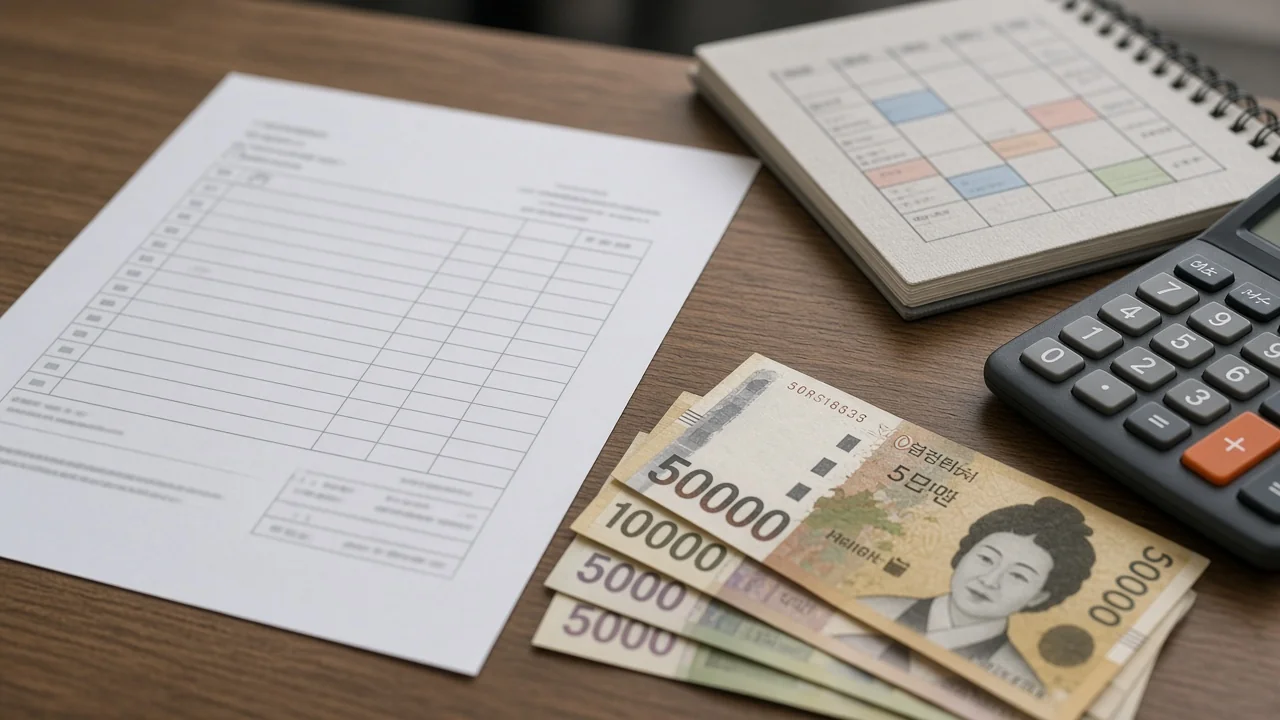

The first payday in Korea is exciting, and then often a little confusing. Why is the number different from hours × wage? What is this extra line called juhyu? Why did a friend at a bigger store get more for the same night shift? This guide explains the rules in plain language with worked examples, so you can check your own pay in five minutes.
Everything here comes from the Labor Standards Act and the Minimum Wage Commission. Where a rule has exceptions, we say so, and we point you to the official helpline rather than guessing.
👉 Want to check a payslip right now? Jump to the 5-minute check.
1. Minimum wage: KRW 10,320 an hour (2026)
The Minimum Wage Commission set the 2026 rate at KRW 10,320 an hour, which is KRW 2,156,880 a month at the standard 209 hours. It applies to every employee regardless of nationality, visa or age. A contract below it is void on that point and the minimum applies anyway. More detail and monthly conversions are in our minimum wage guide.
Probation: an employer may pay 90% of the minimum for up to 3 months only if the contract is for a year or longer, and never for simple-labour jobs such as most cashier, serving and cleaning roles. If someone offers "training wage" below the minimum for a short alba, that is a red flag.
2. Weekly holiday pay (juhyu-sudang)
Under the Labor Standards Act, workers get one paid day off a week. For part-timers it applies when your scheduled hours are 15 or more a week and you worked all your scheduled days that week.
| Scheduled hours a week | Weekly holiday pay (2026) | How |
|---|---|---|
| 14 h | None | Below the 15-hour line |
| 15 h | KRW 30,960 | 15 ÷ 40 × 8 × 10,320 |
| 20 h | KRW 41,280 | 20 ÷ 40 × 8 × 10,320 |
| 25 h | KRW 51,600 | 25 ÷ 40 × 8 × 10,320 |
| 40 h | KRW 82,560 | 8 × 10,320 (cap) |
Watch out for contracts at 14 or 14.5 hours. They are legal, but they deliberately sit under the line. If you actually work more than written, your real hours count; keep a record.

3. Night, overtime and holiday pay (+50%)
At workplaces with 5 or more regular employees, the Labor Standards Act requires at least 50% extra for:
- Night work: any hour between 22:00 and 06:00.
- Overtime: beyond 8 hours a day or 40 hours a week (for part-timers, beyond the hours agreed in the contract also earns the premium).
- Holiday work: work on the weekly paid holiday or statutory holidays.
These can stack: an overtime hour at night is 10,320 × 2.0. At workplaces with fewer than 5 regular staff (many small cafés and convenience stores), these premiums are not mandatory, which explains why two friends on the same night shift can be paid differently.
| Shift (5+ staff workplace) | Calculation | Gross |
|---|---|---|
| 18:00–24:00 (2 night hours) | 4 × 10,320 + 2 × 15,480 | KRW 72,240 |
| 22:00–06:00 night shift (8 h, 1 h unpaid break) | 7 × 15,480 | KRW 108,360 |
| Same shift at a 4-staff store | 7 × 10,320 | KRW 72,240 |
💳 Before your first payday: sort out these three things. Employers pay wages into a Korean account, tax is withheld from some payslips, and if you send money home the exchange rate decides how much actually arrives.
4. Deductions: why take-home is lower
- Income tax: depends on whether you are paid as an employee or as a freelancer (3.3% withholding is the common freelancer rate). Small part-time wages often have little or no income tax; our tax guide for student workers explains year-end settlement and refunds.
- Social insurance: employment insurance, national pension and health insurance may be deducted depending on your hours, contract and visa. Pension contributions may be refundable when you leave Korea; see the pension refund guide.
- Anything else (uniform, shortages, "fines" for lateness) cannot simply be taken from wages without a legal basis or your agreement; the Labor Standards Act requires wages be paid in full.
Profile card · The student reading a payslip for the first time
EVERY LINE HAS A NAME.
Base pay, weekly holiday pay, night allowance, deductions. Once you can read it, nobody can confuse you.
Screenshot your payslip every month and keep it.
5. Your 5-minute payslip check
- Count your actual hours (from your own notes or schedule app).
- Hours × hourly wage. Is the hourly rate at least 10,320?
- Scheduled 15+ hours a week? Add weekly holiday pay for each full week.
- 5+ staff workplace? Add 50% on night, overtime and holiday hours.
- Compare with the payslip lines. The employer must give you an itemised payslip every payday (Labor Standards Act Art. 48, since 19 Nov 2021).
- Check the deposit in your account. No account yet? Open a Korean bank account first; wages should be paid directly to you.

6. The written contract
The employer must put in writing your wage (and how it is calculated and paid), working hours, holidays and annual leave, and give you a copy. The Ministry of Employment and Labor publishes standard contract forms, including one for short-time workers, in several languages. Never start without one, especially if you are a student: immigration needs it for your part-time permit.
7. Other rights people forget
- Breaks: 30 minutes per 4 hours, 1 hour per 8 hours.
- Annual leave: applies to workers with 15+ hours a week at workplaces with 5+ staff.
- Severance: after 1 year of continuous work at 15+ hours a week on average.
- Industrial accident insurance: covers work injuries regardless of nationality.
What workers say (honest summary)
About the "what workers say" section: we did not run a survey. It summarises themes that come up again and again in public job-board reviews, student community posts and labour-office FAQs, and we have kept it honest, good and bad.
- 👍 "Once I learned juhyu, I checked every contract for the 15-hour line."
- 👍 The 1350 helpline is mentioned often as useful, with interpretation available.
- 👎 Late payment and cash-in-hand jobs are the most common complaints; they leave no record. Prefer bank transfer and a payslip.
- 👎 Confusion between 3.3% freelancer pay and employee pay; ask which one you are before you start.
8. If you are not paid
- Collect evidence: contract, schedule, messages, bank deposits, photos of timesheets.
- Ask the employer politely in writing (a message is fine).
- Call the Ministry of Employment and Labor on 1350 or file a wage complaint with the local labour office; support centres for foreign workers can help with language.
- Your visa status does not remove your right to wages for work already done, but working without a permit has its own consequences; ask 1345 about your status.
Sending your savings home? Compare the won exchange rate and remittance apps before you transfer.
| Rule | What it means for you | Source |
|---|---|---|
| Minimum wage 2026 | KRW 10,320 an hour for every worker, foreign or Korean, full- or part-time | Minimum Wage Commission |
| Weekly holiday pay | If you are scheduled 15+ hours a week and work all scheduled days, you earn one extra paid day | Labor Standards Act Art. 55 and 18 |
| Night, overtime, holiday premium | +50% for work 22:00–06:00, beyond 8 h/day or 40 h/week, or on holidays, at workplaces with 5+ regular staff | Labor Standards Act Art. 56 |
| Breaks | At least 30 minutes for 4 hours of work, 1 hour for 8 hours | Labor Standards Act Art. 54 |
| Written contract | Wage, hours, holidays and leave in writing, with a copy for you | Labor Standards Act Art. 17 |
| Payslip | Itemised pay statement every payday (mandatory since 19 Nov 2021) | Labor Standards Act Art. 48 |
| Severance | After 1 year at 15+ hours a week on average | Employee Retirement Benefit Security Act |
🧭 More part-time job guides for foreigners
Compare the other common alba before you pick one.
 🗓️ Hours guideWeekend & Vacation HoursHoliday pay, night pay, caps📝 Rights guideContract & Payslip WalkthroughLine by line, before you sign
 ⚖️ Rights guideUnpaid Wages & the 1350 HelplineEvidence, complaints, getting paid
 🐷 Rights guideSeverance & 4 InsurancesWhat part-timers are owed
 🧾 Tax guideYear-End Tax SettlementRefund basics for part-timers
All part-time job guides: Convenience Store Jobs in Korea · Café Jobs in Korea · Restaurant & Kitchen Jobs · Duty-Free & Shop Jobs · Hotel & Housekeeping Jobs · Kids Café & English Camp Jobs · Warehouse & Logistics Jobs · Academy (Hagwon) Assistant Jobs · Event & Promotion Staff Jobs · Albamon & Alba Heaven Guide · Unpaid Wages & the 1350 Helpline · Delivery & Rider Jobs · Translation & Interpreting Alba · Tour Guide Assistant Jobs · Tutoring Rules for Students · PC Bang & Karaoke Jobs · Contract & Payslip Walkthrough · Seasonal Farm Work (E-8) · Gym & Fitness Part-Time · Mart & Supermarket Jobs · Call Centre & Support Jobs · D-10 Job-Seeking Visa · E-9 & the EPS Explained · F-Visa Work Rights · Internships for Foreign Students · Campus Jobs for Foreign Students · E-7 Jobs After Graduation · Freelance & Gig Work Rules · Severance & 4 Insurances · Workplace Injury Claims · Restaurant Hall Staff Jobs · Pharmacy & Clinic Reception · Moving & Cleaning Day Labour · Year-End Tax Settlement · D-4 Language Student Work · Labour Office Complaint · Career Certificate · Weekend & Vacation Hours · Bakery & Dessert Shop · Cinema Part-Time Jobs · Workplace Harassment · Resigning from a Part-Time Job · How to Read a Payslip · Study Café Part-Time Jobs · Housing & Commute Near Work · Interview Prep for Part-Time Jobs · Gas Station Part-Time Jobs · Night-Shift Logistics Work · Switching Jobs Mid-Semester · Small Workplaces (Under 5) · Winter Vacation Part-Time Jobs · Renewing Your ARC While Working · Takeout & Delivery Counter Jobs · Bookstore & Stationery Jobs · Hotel Front Desk Part-Time · Dishwashing & Kitchen Support · Language-Exchange Café Jobs · Summer Vacation Part-Time Jobs · Banking When Your ARC Is Expiring · Freelance Translation Rules · From Payslip to Tax Filing · Pet Café Part-Time Jobs · Photo Studio Assistant Jobs · Parcel Counter Part-Time Jobs · Drugstore & Beauty Floor Staff · Florist Part-Time Jobs · Laundry & Dry-Cleaner Counter · Car Wash Part-Time Jobs · Golf Driving Range Staff · Academy Front Desk Admin · Bike & Scooter Rental Counter · Bowling Alley & Ice Rink Desk · Karaoke Room Counter Jobs · Wedding Hall Banquet Staff · Museum & Gallery Attendant · Theme Park Guest Ops Staff · Library Assistant Jobs · Stadium Usher & Gate Staff · Hostel & Guesthouse Reception · Aquarium & Zoo Ticket Desk · Ski Resort Rental Desk · Water Park Locker & Towel Desk · Concert Merch Booth Staff · Escape Room & VR Cafe Counter · Temple Stay & Cultural Centre Desk
Sources
- Minimum Wage Act, Article 5 (probation reduction rules).
- Ministry of Employment and Labor, standard employment contract forms.
- Income Tax Act withholding on business income (3.3% incl. local tax), National Tax Service.
- Minimum Wage Commission, 2026 minimum wage notice (KRW 10,320/hour); Albamon notice, 26 Dec 2025.
- Labor Standards Act, Articles 17, 18, 48, 54, 55, 56 (Korea Law Information Center).
- Study in Korea (NIIED), "Part-Time Work for International Students", checked 2 Nov 2026.
- Easylaw (Ministry of Government Legislation), "Foreign Students: Part-time work".
- Albamon H1 2023 hourly-wage big-data analysis (2.14 million postings), reported by Asia Economy, 27 Jul 2023.
- Ministry of Employment and Labor helpline 1350; Immigration Contact Center 1345.
FAQ: part-time pay in Korea
What is the minimum wage in Korea in 2026?
KRW 10,320 an hour, for all workers regardless of nationality.
Who gets weekly holiday pay?
Workers scheduled 15+ hours a week who work all scheduled days that week. At 20 hours a week it is about KRW 41,280 in 2026.
Do part-timers get night pay?
At workplaces with 5+ regular employees, hours between 22:00 and 06:00 pay at least 50% extra. Smaller workplaces are not required to.
Is my employer required to give me a payslip?
Yes, an itemised payslip every payday since 19 November 2021.
Where do I report unpaid wages?
The Ministry of Employment and Labor helpline 1350 or your local labour office.
ℹ️ This article is general information, not legal advice. Rules and procedures can change — check the official sources linked above for the latest details.
Was this worth your time?
Tap a star to rate it. One vote per reader.
No ratings yet. Be the first.
💬 Comments
- Be the first to comment.